Autumn is the French Alps’ best-kept secret. From September to October, the mountains undergo a transformation that most visitors never see: the summer crowds vanish, the larch forests turn gold, the trails empty out and the light takes on that particular quality — low, golden, long — that makes the landscape feel like a painting. Lake temperatures are still warm enough to swim in September. Hiking conditions are at their finest. Prices drop sharply from August. If you have been to the French Alps only in winter or high summer, autumn will feel like a completely different place.
🍂 Autumn at a glance:
- September — the finest month. Stable weather, warm lakes, peak hiking season, empty trails, 20–40% cheaper than August. Full September guide →
- October — peak larch colour, quietest villages, lowest prices of the year. Hiking below 2,000 m, Southern Alps for sunshine. Full October guide →
- November — city breaks, thermal spas, first ski openings (Val Thorens, Tignes). Full November guide →
Why autumn in the French Alps?
The case for autumn is straightforward. The French Alps in July and August are magnificent but crowded — roads gridlocked, trails busy, accommodation expensive and hard to book. September clears all of that in a single week. The French school holidays end in early September, and the mountains immediately empty. The same trails, the same lakes, the same villages — but with room to breathe. Then in October the colours arrive: the larch forests (the only deciduous conifers in the Alps) turn from green to vivid gold, creating a spectacle that rivals New England in fall and is almost entirely unknown to non-French visitors.
The autumn colours — the larches
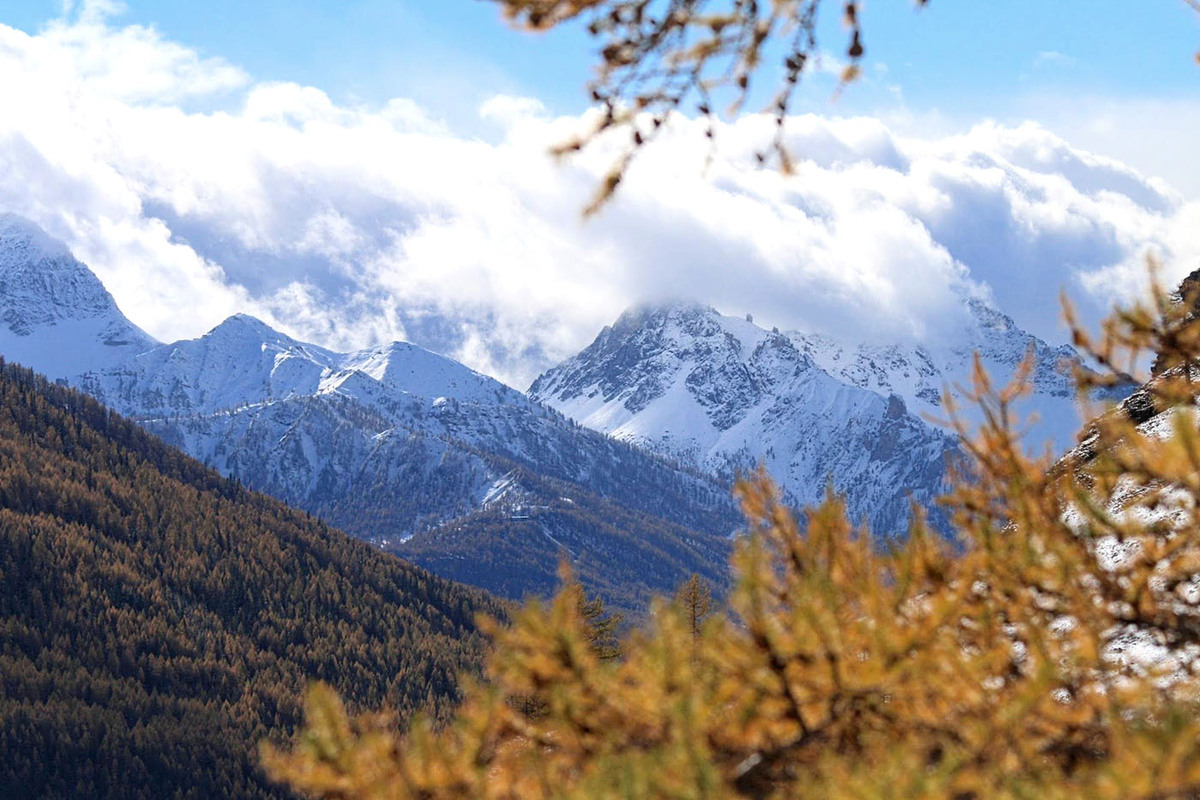
The larch (Larix decidua) is unique among Alpine conifers — it loses its needles in winter, turning from green to vivid gold before doing so. Between mid-September and mid-October, the hillsides between 1,400 and 2,000 m are transformed: entire mountain faces of deep gold against the first snow on the summits and the deep blue of October sky. It is one of the great natural spectacles in Europe — and one that barely features in mainstream travel coverage of the French Alps.
The timing by altitude:
- Above 1,800 m: colour from mid-September, peak in late September
- 1,400–1,800 m: peak colour in the first two weeks of October
- Below 1,400 m: colour from mid-October (mixed deciduous — beech, maple, ash)
The finest destinations for larch colour: the Vallée de Névache above Briançon (the most spectacular larch forests in the Alps), Arêches-Beaufort in the Beaufortain, the Col de la Croix de Fer approach roads in the Maurienne, the Queyras regional park and the Alpe d’Huez forest above Bourg-d’Oisans.
September — the finest autumn month

September is, by most measures, the finest month to visit the French Alps. The weather is stable and warm (20–24°C in valley towns), the lakes are still swimmable (19–22°C), the mountain huts are open for multi-day routes, the hiking trails are dry and empty and the light is exceptional. For those with flexibility in their travel dates, September is almost always the answer.
Key September highlights: Lake Annecy cycle circuit in the morning cool, a swim at Lac d’Aiguebelette (still 22–24°C), multi-day hiking on the Tour du Mont Blanc (quietest and most bookable of the season), road cycling on the great alpine cols with virtually no traffic. For a full breakdown of what to do in September, see our complete September guide.
October — larch colour and low prices
October narrows the options but sharpens the rewards. Hiking above 2,000 m becomes difficult after mid-month; lake swimming is over by mid-October; some resort facilities close for the inter-season. What remains is extraordinary: peak larch colour in the forests, the mountain villages at their most authentic, the Southern Alps still warm and sunny, the thermal spas inviting in the first cold. October is the month for photography, for slow travel, for discovering the Alps without the summer or winter apparatus of tourism.
The Southern Alps deserve particular mention for October. While the Northern Alps can be grey and wet during Atlantic weather fronts, Briançon, the Queyras, the Ubaye valley and Haute-Provence retain Mediterranean sunshine well into the month. Embrun averages 189 hours of October sunshine versus Chambéry’s 118. Combined with the larch colour, this makes the Southern Alps arguably the finest autumn destination in all of France. For a full breakdown, see our complete October guide.
Hiking in autumn

Autumn is the finest season for hiking in the French Alps — specifically early autumn (September to mid-October). The trails are dry and well-maintained after summer use, the mountain huts are still open in September, the afternoon thunderstorm risk is significantly lower than in July or August and the light is exceptional. By contrast, October requires more care: above 2,000 m, snow and ice can appear from mid-month and huts close in early October.
The best autumn hiking zones by objective:
- Multi-day routes (September): Tour du Mont Blanc, GR5 through the Vanoise, Tour des Écrins — all at their quietest and most enjoyable in September. Same-week hut bookings often possible.
- Day walks (September–October): Plateau d’Emparis (Hautes-Alpes), Lac Blanc (Chamonix), Hauts Plateaux du Vercors, Semnoz ridge (Annecy) — all excellent in autumn.
- Late October: pre-Alpine massifs only — Vercors (beech forests, limestone plateau), Chartreuse (south-facing paths), Baronnies provençales (semi-Mediterranean, snow-free into November).
Best autumn destinations
Briançon and the Southern Alps ⭐
The standout autumn destination. Briançon combines a UNESCO World Heritage old town (Vauban fortifications), exceptional sunshine (one of the sunniest towns in France at 1,326 m), the Névache valley larch forests 20 minutes away, the Serre Chevalier thermal baths open year-round and access to the Queyras and Écrins parks for hiking. In October especially — when the Northern Alps can be grey — the Southern Alps light makes Briançon and its surroundings feel almost Italian in quality.
Arêches-Beaufort and the Beaufortain
An authentic Savoie valley with no major ski resort infrastructure and exceptional autumn character. The Roselend reservoir, the Cormet de Roselend cycling climb, the larch forests and the Beaufort cheese farms (the AOC Beaufort is one of the finest mountain cheeses in France, produced in this valley) make for a completely satisfying autumn week without needing to look further. The village of Arêches-Beaufort itself is one of the most genuine mountain villages in the Northern Alps.
Chamonix in September
Chamonix in September is at its most enjoyable — the valley is emptying, the Aiguille du Midi cable car and Montenvers cog railway still run year-round, the QC Terme spa is open and the walking above the valley (from mid-June to October) is exceptional. Hotel prices are 30–40% below August. See our full Chamonix hotel guide.
Annecy in September and October
Annecy in autumn is one of the finest urban experiences in the Alps. The old town, the lake and the surrounding mountains are at their most photogenic in the low autumn light. The lake cycle circuit (37 km) is outstanding in September cool. The Aravis peaks above take on their first dusting of snow in October — a spectacular backdrop to the lake. See our guide to things to do around Annecy.
FAQ — autumn in the French Alps
September is the finest autumn month — stable weather, warm lakes, excellent hiking, mountain huts open and prices well below August. October is best for larch colour and the most dramatic autumn landscapes, but the weather is more variable and hiking is restricted above 2,000 m from mid-month. November is for city breaks, thermal spas and early season skiing rather than outdoor autumn activities.
The larch forests are at their peak colour between late September (above 1,800 m) and mid-October (at 1,400–1,800 m). A visit in the first two weeks of October almost always catches peak colour somewhere in the Alps, regardless of altitude. The best destinations: Vallée de Névache, Arêches-Beaufort, Queyras and the Col de la Croix de Fer approach roads.
Yes — September and early October are excellent for hiking below 2,000 m. The trails are dry, the huts are open in September and the light is exceptional. Above 2,000 m, snow arrives from mid-October. Multi-day routes (Tour du Mont Blanc, GR5) are fully viable in September. By late October, hiking is best restricted to the pre-Alpine massifs (Vercors, Chartreuse, Baronnies) below 1,500 m.
September: 20–24°C in valley towns, 16–18°C at 1,500 m. October: 13–18°C in valleys, cold nights at altitude. November: 8–12°C in valleys, full winter above 1,500 m. The Southern Alps are consistently 3–5°C warmer than the Northern Alps in autumn and receive significantly more sunshine.
In September, yes — the major Alpine lakes (Annecy, Bourget, Aiguebelette, Léman) reach 19–22°C at the surface, which is perfectly swimmable. Aiguebelette, one of the warmest natural lakes in France, can reach 23–24°C in early September. By mid-October, temperatures drop to 15–17°C — cold for most swimmers. Lifeguarded beach areas generally close around 15 September.
👉 Read also: French Alps in September — complete guide · French Alps in October — complete guide · French Alps in November — complete guide · 15 legendary cycling climbs in the French Alps