Cycling around Lake Annecy is one of the great easy rides in the Alps — and one that consistently surprises people who expect a serious challenge. The circuit is 37 km with just one real climb: the Roc du Chère above Talloires, 100 m of ascent over 1.5 km at a manageable 6.5% gradient. The rest is almost entirely flat, following a dedicated cycle path along the former railway line on the western shore and quiet lakeside roads on the eastern side. Crystal-clear water throughout, one of the most photogenic lakes in France and a route that works equally well for families, leisure cyclists and those looking for a solid half-day out. Add the Col de la Forclaz variant and you have a serious 49 km alpine ride with 720 m of climbing.
✅ Route summary:
- 📏 Distance: 37 km (standard circuit) · 49 km with Col de la Forclaz variant
- 📈 Elevation gain: 200 m (standard) · 920 m with Forclaz variant
- ⌛ Time: 1h30 (sporty pace) · 2h30–3h (leisure) · 3–4h (family with stops)
- 💪 Difficulty: easy to moderate — one climb above Talloires (1.5 km at 6.5%), rest is flat. Excellent on an e-bike.
- 📍 Highlights: Talloires bay, lake beaches, Annecy old town, Château de Menthon, Duingt castle
Where to start
The best starting point is the Parking des Marquisats on the southern edge of Annecy, directly on the cycle path and close to the motorway exit. Several bike hire shops are within a few minutes’ walk — convenient if you haven’t brought your own. Alternatively, start from Annecy train station (a short ride to the cycle path) or from the southern end of the lake at Doussard if arriving from the south, where parking is easier and the lakeside is quieter.
Bike hire in Annecy costs around €25 for a half-day for a standard bike, or €35–45 for an e-bike. Several hire shops are clustered near the old town and along the lakeside. Booking ahead in July and August is advisable — hire bikes sell out quickly in peak season. Book bike hire online →
The route: anticlockwise (our recommended direction)
Most guides suggest riding clockwise — tackling the Talloires climb gradually from the north. We prefer anticlockwise: the western cycle path is faster and more satisfying in the first half, the legs are fresher for the short sharp climb above Talloires, and the descent into Menthon-Saint-Bernard and return along the eastern shore make for an excellent finish. Both directions work well; the choice comes down to personal preference.
Section 1 — Annecy to the southern end of the lake (18 km, flat)
From the Marquisats car park, pick up the cycle path heading south and follow it for 18 km to the foot of the lake. This is the finest section of the circuit: a dedicated path built on the former railway trackbed, almost entirely traffic-free, running along the western shore with continuous lake views. The path passes through Sévrier, Duingt (where a short tunnel cuts through a small rocky headland) and on to Doussard at the lake’s southern end.
A practical note: in summer and on weekends, this path can be very busy — particularly between Annecy and Duingt. The road alongside is gridlocked; the cycle path, though crowded, keeps moving. It is one of those situations where cycling is genuinely faster than driving.


Section 2 — Southern end to Talloires bay (8 km, flat)
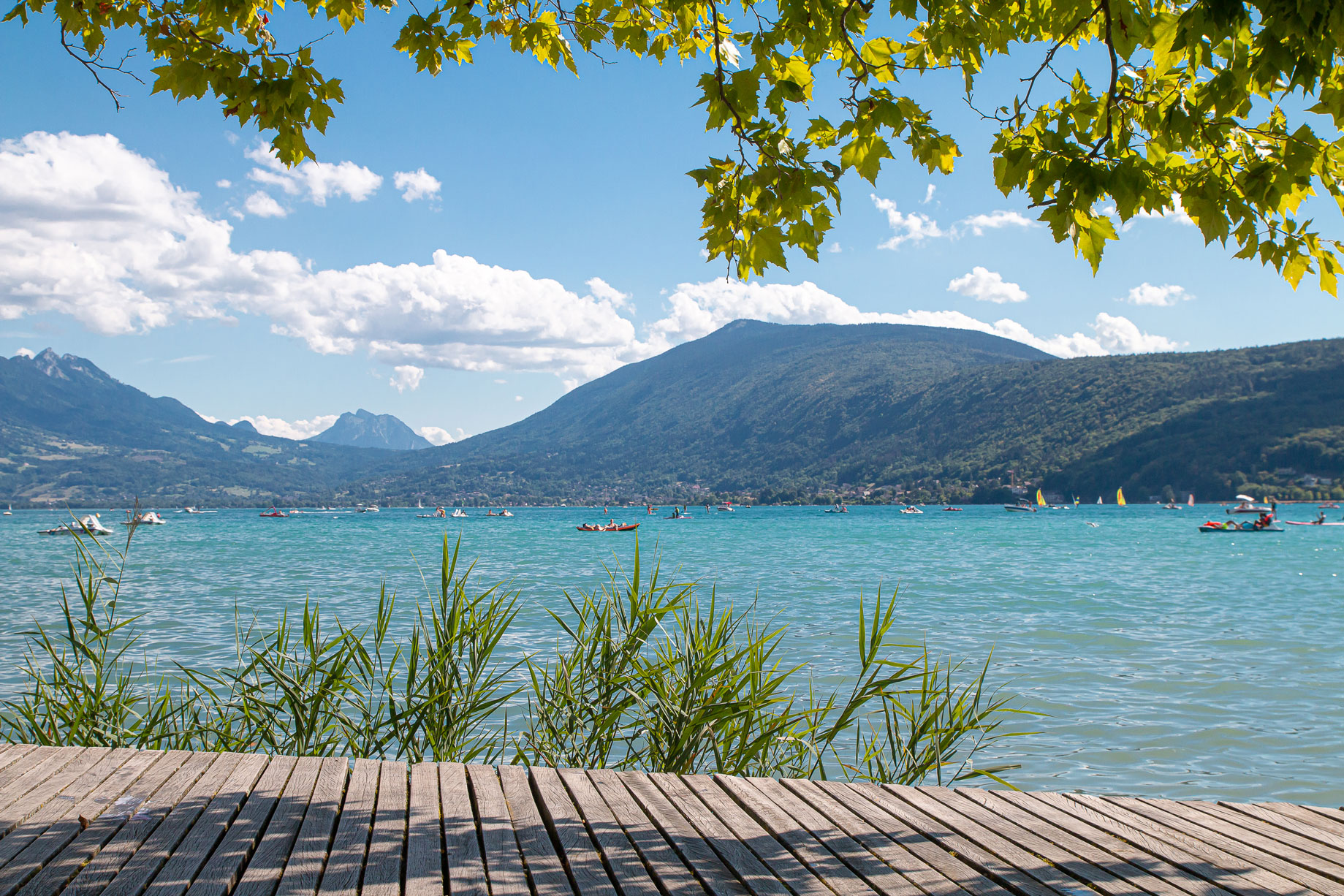
At the foot of the lake, the cycle path continues briefly southward towards Faverges before a clearly signed left turn through an underpass leads to the eastern shore. The path extension completed in 2020 means this transition is now almost entirely traffic-free. The eastern shore is quieter and more intimate than the western side — smaller villages, narrower roads, the lake seemingly closer. The bay of Talloires, reached after around 8 km, is one of the finest spots on the circuit: a deep, sheltered bay with a medieval village, Michelin-starred restaurants and clear turquoise water. Worth stopping for.
Section 3 — The Talloires climb: 1.5 km at 6.5%
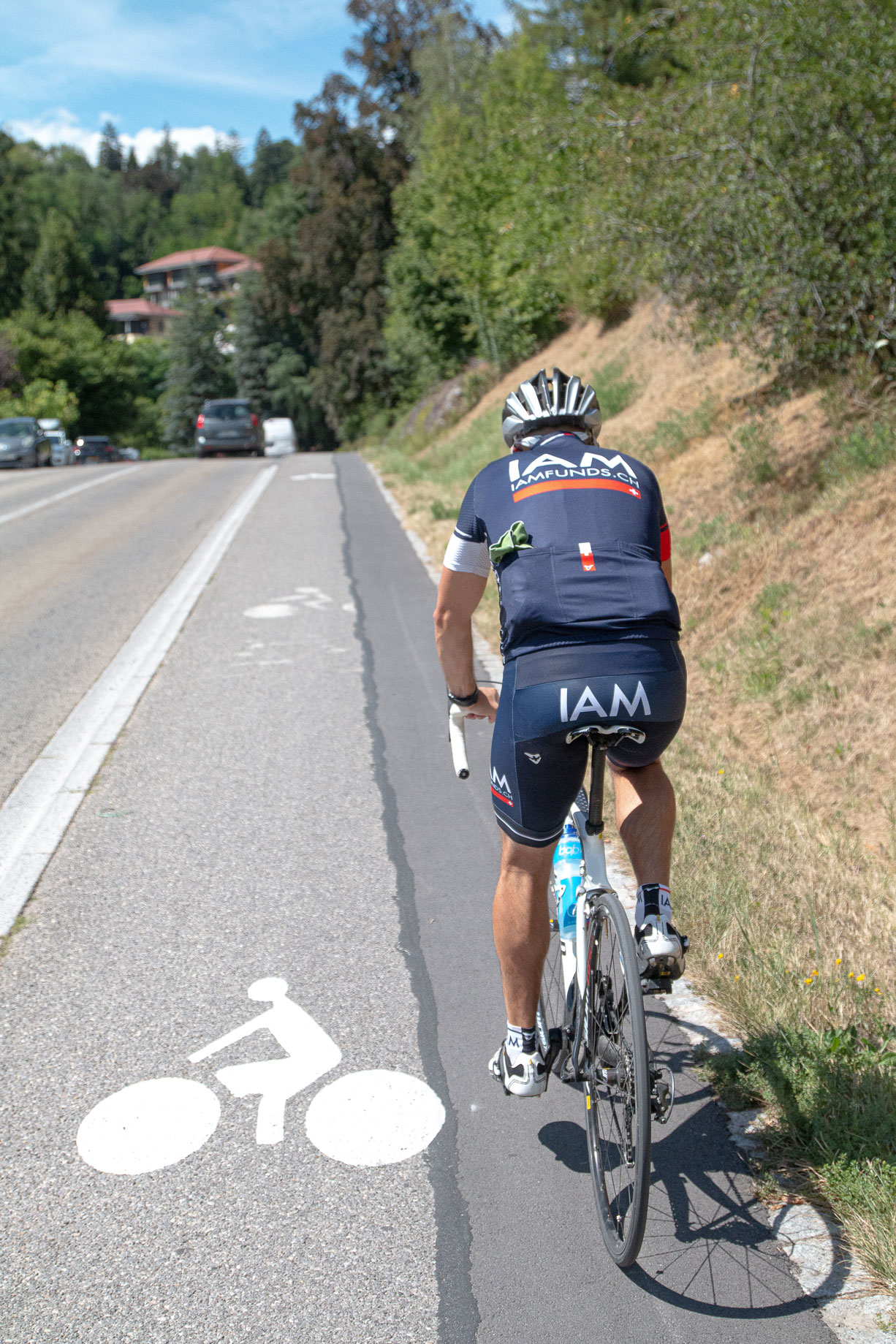
The only real effort of the circuit. Above Talloires, the road climbs over the Roc du Chère — 1.5 km, 100 m of ascent, averaging 6.5%. There is a dedicated cycle lane throughout, keeping you clear of traffic. The gradient is steady rather than brutal. On an e-bike it barely registers; on a standard bike with any reasonable fitness, it takes 10–15 minutes. Walking is an option, but pushing a loaded bike uphill for 1.5 km is probably more tiring than riding it.

Section 4 — Return to Annecy via Menthon and Veyrier (11 km)
From the top of the Roc du Chère, the road descends quickly to Menthon-Saint-Bernard — a beautiful village with a lakeside château (said to have inspired Walt Disney’s Sleeping Beauty castle) and excellent swimming from its wooden jetties. The route continues through Veyrier-du-Lac, slightly more urban and busy, before a dedicated cycle path picks up again at the exit of the village and runs all the way back into Annecy along the Pâquier — the long lakeside lawn at the heart of the old town. This last section is the least tranquil of the four, but the arrival back into Annecy with the lake on one side and the old town on the other is a fine finish.
Map of the Lake Annecy cycle circuit
The map below shows the full circuit. Dark green sections are fully traffic-free cycle paths; light green sections are dedicated cycle lanes on shared roads. Of the 37 km total, more than 30 km have dedicated cycling infrastructure. Only the central sections through Menthon-Saint-Bernard and Veyrier-du-Lac run on mixed-traffic roads — and these are calm enough that most cyclists find them comfortable.
Where to stop
- Lake beaches: around fifteen beaches ring the lake, most open from June to September with lifeguards, water sports hire and snack bars. The water temperature reaches 20°C+ in summer — a mid-circuit swim is very much part of the experience. See our guide to the best beaches on Lake Annecy.
- Talloires bay: the most beautiful stop on the circuit. Turn left off the main road into the village before the climb begins — the bay, the abbey and the lakeside are a few hundred metres down. The Auberge du Père Bise (chef Jean Sulpice, two Michelin stars) is one of the finest restaurants in Haute-Savoie and sits directly on the water.
- Menthon-Saint-Bernard: after the descent from the Roc du Chère, the wooden jetties at Menthon offer some of the best swimming on the circuit with the château as backdrop. The Château de Menthon (12th–17th century) is open for visits — the Disney connection, whether apocryphal or not, makes a good story.
- Duingt: the small island castle visible from the cycle path is the Château de Duingt, privately owned but photogenic from the water’s edge. A good point to refuel at one of the village cafés mid-circuit.
- Sévrier: the Musée Paccard tells the story of the world-famous bell foundry that has been casting and tuning bells here since 1796 — an unexpectedly interesting stop for those who want more than lake views.
The sporty variant: Col de la Forclaz (49 km, 920 m)
For those wanting a genuine alpine cycling challenge, the Col de la Forclaz variant adds 12 km and 720 m of climbing to the standard circuit. At the southern end of the lake, instead of crossing to the eastern shore, continue on the cycle path towards Faverges, then turn off at Giez towards Montmin and the col. The climb is 9 km at approximately 8% — the first few kilometres exceed 10% and will test anyone not accustomed to alpine gradients. The reward is one of the finest views in the French Alps: the entire Lake Annecy from 1,150 m, with the Aravis massif behind and the Bauges to the west. The descent to Menthon-Saint-Bernard rejoins the standard circuit.
The col can be ridden from either direction. The southern approach (via Giez) is more sustained; the northern descent towards Menthon is more technical with steeper hairpins. If you are not confident on steep descents, approach from the north instead.
Other cycling routes near Annecy
For stronger riders looking to extend beyond the lake circuit, the surrounding massifs offer excellent options. The Semnoz ridge (1,700 m) is a classic Haute-Savoie climb accessible from Annecy. The Col de Leschaux, Col de Merdassier and Col des Aravis add serious alpine distance. Further afield, the Lac du Bourget circuit (50 km, 600 m) is a harder but equally rewarding ride from Aix-les-Bains — clearly more demanding than the Lake Annecy circuit.
FAQ — cycling around Lake Annecy
Allow 1h30 at a brisk pace, 2h30–3h at a leisure pace with a few photo stops, and 3–4h for a family outing with swimming and lunch. The circuit is 37 km with around 200 m of total climbing — very manageable for most cyclists.
Clockwise (western shore first) is often recommended for families and beginners — the Talloires climb comes gradually from the north, spread over several smaller rises. Anticlockwise gives a fast flat start on the traffic-free voie verte before the short sharp climb above Talloires. Both work well; the clockwise direction is marginally more comfortable for less experienced riders.
Yes — it is one of the best family cycling circuits in the French Alps. Over 30 of the 37 km are on dedicated cycle paths or quiet roads. The one challenge is the 1.5 km climb above Talloires (6.5%), which is manageable for most children over 10 on a standard bike and trivial on an e-bike. E-bikes are strongly recommended for families with younger children or less confident riders.
Yes — several hire shops operate near the old town and lakeside. Standard bikes cost around €25 for a half-day; e-bikes around €35–45. In July and August, booking ahead is strongly advisable as hire bikes sell out quickly. Electric bikes are available from most hire points and make the Talloires climb much easier.
Yes — lake shuttle boats and the SIBRA bus line 51 (with bike racks, seasonal) both provide an escape route if needed. The Annecy–Talloires–Doussard boat service allows you to cut the circuit in half if the Talloires climb or the return feels too much. Schedules and prices are available at the Annecy tourist office.
May to October. June is excellent — the lake is warming up, the flowers are out and the path is busy but not yet at peak summer congestion. July and August are the busiest months (path can feel like a motorway between Annecy and Duingt). September is perhaps the finest month: warm, quieter and the light is exceptional.
👉 Read also: 50 best things to do around Annecy · Best beaches on Lake Annecy · Cycling around Lac du Bourget · French Alps in June