Italy feels close from the French Alps — separated only by a handful of summits above 3,000 m. Crossing is straightforward enough, but the mountain dictates the terms: tunnels are expensive, passes are seasonal, and the train options are fewer than you might expect. Whether you want the fastest motorised crossing, a scenic road alternative, or the adventure of cycling or walking from north to south, this guide covers every option — with costs, timings and practical advice for 2026.
By car — fast tunnels or scenic passes?
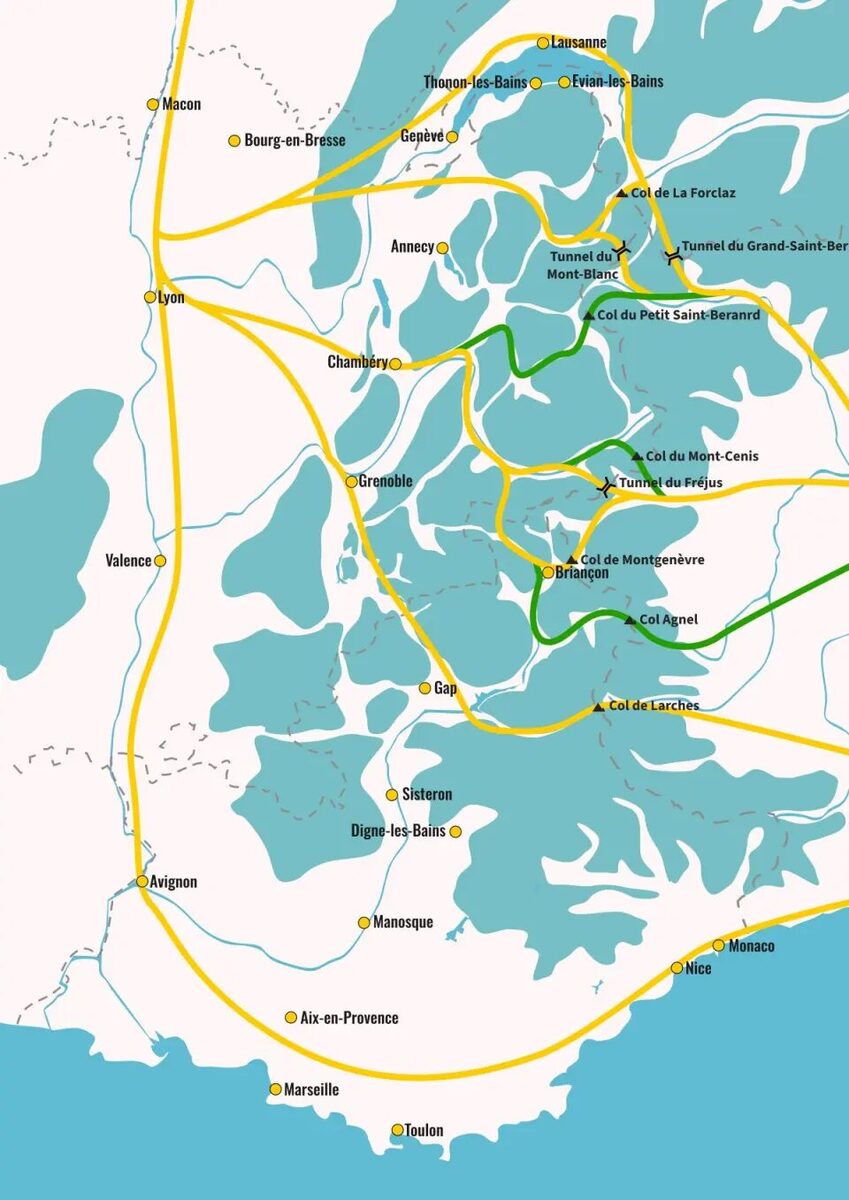
For drivers, two main arteries have historically dominated the France–Italy crossing: the Mont Blanc tunnel in northern Haute-Savoie and the Fréjus tunnel in the southern Maurienne valley. Both are fast and reliable year-round — but expensive, and subject to heavy traffic and planned closures for maintenance.
In 2026, the Mont Blanc tunnel costs around €70.40 return. The Fréjus tunnel (accessed via the A43 motorway through the Maurienne) costs around €69.20 return. Both tunnels close periodically for overnight or extended maintenance — check ahead before travelling.
In winter, when the high passes are closed by snow, the alternatives narrow considerably. The Grand-Saint-Bernard tunnel (Switzerland) is the main northern option — but requires a Swiss motorway vignette (~€44) plus tunnel toll (~€53.50 return). Further south, the Col de Larche (1,991 m) and Col de Montgenèvre are usually kept open through winter except in extreme conditions. And from the south of France, the Côte d’Azur coastal route avoids the Alps entirely.
From mid-May to mid-November, the mountains open up and free alternatives become viable — with spectacular scenery as a bonus:
- Col du Petit-Saint-Bernard (2,188 m) — the closest and most economical alternative to the Mont Blanc tunnel, giving direct access to the Aosta Valley. Free, and one of the most beautiful drives in the Alps.
- Col du Mont-Cenis (2,083 m) — the natural alternative to the Fréjus, accessed from the Haute-Maurienne. The pass road crests above a vast turquoise lake before dropping into the Susa valley in Italy.
For full detail on both main tunnels and their alternatives:
👉 Alternatives to the Mont Blanc tunnel
👉 Alternatives to the Fréjus tunnel
By train — the relaxed crossing
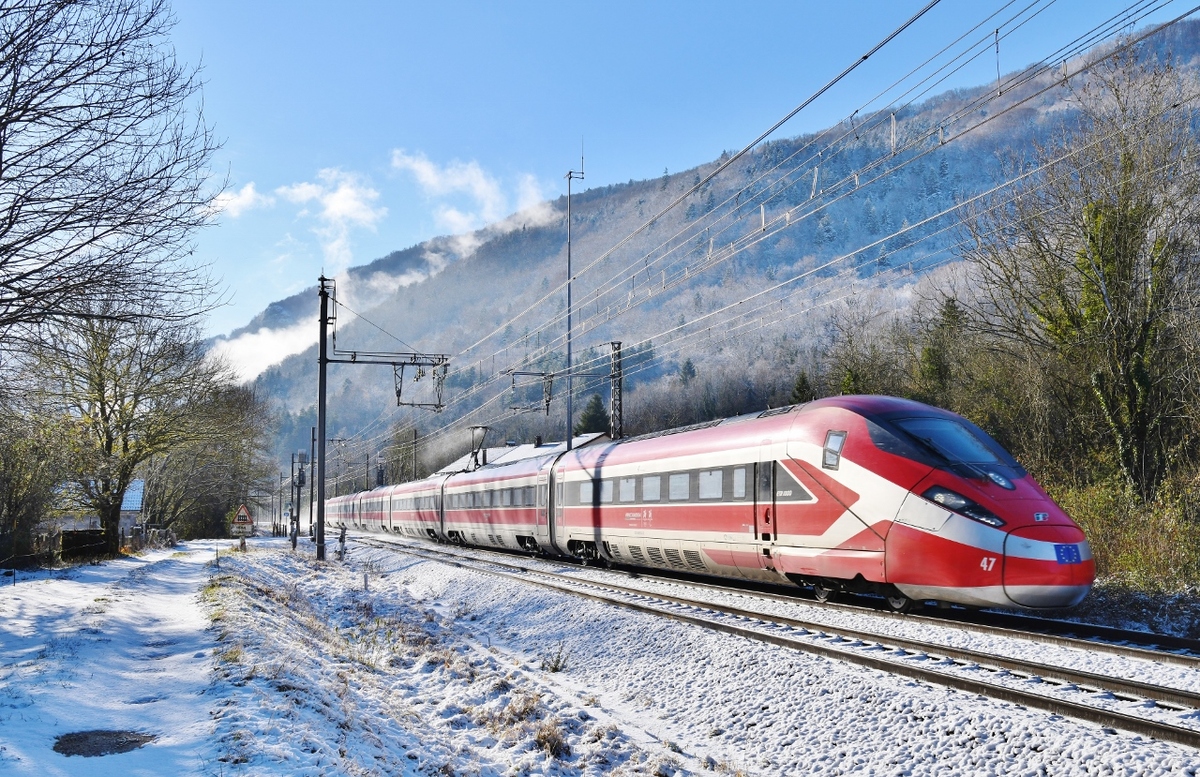
The train is a genuine option for crossing the Alps into Italy — though route choices are limited. The main axis is the classic Paris–Lyon–Turin–Milan corridor, which crosses the massif without any concern for snow or traffic, running 12 months a year. In the south, local TER services connect Nice to Ventimiglia on the Italian border, where you transfer to the Italian network.
On the main axis, both SNCF and Trenitalia run high-speed services with stops in the Alpine valleys. Paris to Milan takes around 7 hours, of which roughly 3 hours traverse the Alps. Several crossings run daily in each direction. Booking in advance gives significantly better prices on both operators.
For UK visitors, Eurostar connects London St Pancras to Paris in around 2h20, but there is no direct London–Milan rail service. You will need to change — at Paris, Lyon or Chambéry — onto a TGV or Trenitalia service for the onward journey to Turin or Milan. Total journey time from London is typically 9–11 hours depending on connections, and worth comparing against flying once airport time and check-in are factored in.
By bike — the great traverse
If your goal is less to get to Italy quickly and more to cross the Alpine massif from north to south, road cycling is the ideal medium. Two major itineraries exist, depending on your level of commitment.
- La Route des Grandes Alpes — the classic challenge
Reserved for well-prepared cyclists, the Route des Grandes Alpes runs 720 km from Thonon-les-Bains on Lake Geneva to Nice on the Mediterranean. It climbs 19,600 m of ascent across 26 stages rated Difficult to Very Difficult, crossing the highest road passes in Europe — including the Col de l’Iseran (2,764 m) and the Col du Galibier (2,642 m). E-bike charging points now exist every 30–40 km along the full route, making it more accessible than it once was.
See our guide to the legendary Alpine cycling climbs. - Les P’tites Routes du Soleil — the gentle alternative
For a more accessible approach, this 900+ km route follows the western Alpine foothills from Haute-Savoie to the Alpes-Maritimes, with no pass above 1,400 m. 21 sections cross 7 departments and 9 pre-Alpine massifs including the Chartreuse and the Vercors — a genuine slow travel itinerary through some of the least-visited terrain in the Alps. A gravel variant is currently in development. - Crossing to Italy by bike — not all passes are equal, and summer roads can be busy. The Col du Petit-Saint-Bernard is the best northern option for a France–Italy crossing on two wheels; the Col du Mont-Cenis and Col de Montgenèvre are good further south. The Col de Larche sees lighter traffic than the Lautaret or Montgenèvre routes. The highest road crossing is the Col Agnel at 2,743 m.
On foot — from long-distance trail to border crossing
For walkers, crossing the Alps is a pilgrimage. The north–south axis is dominated by the legendary GR5 (Grande Traversée des Alpes), which runs approximately 600 km from Lake Geneva to the Mediterranean — around 40 stages of complete immersion in the mountains, passing through the Chablais, Beaufortain, Vanoise and Queyras before reaching the Mercantour.
For a simple France–Italy border crossing on foot, several historic mule tracks and smugglers’ paths are perfectly accessible to experienced hikers. The most popular pedestrian passes into Italy:
- Col de la Seigne (2,516 m) — a classic stage on the Tour du Mont-Blanc, with a striking view over the southern face of the massif into the Aosta Valley.
- Col de la Roue (2,541 m) — a wild crossing linking the Maurienne valley to Piedmont.
- Col de la Vallée Étroite (2,434 m) — a beautiful and accessible path linking Valfréjus on the French side to a curious Italian enclave popular with summer hikers.
- Col du Longet (2,647 m) or Col de Mary (2,641 m) — magnificent high passes in the Haute-Ubaye, dropping directly into the Italian Maira valley.
👉 Read also: Alternatives to the Mont Blanc tunnel · Alternatives to the Fréjus tunnel · The most beautiful Italian lakes · The Italian lakes closest to the French Alps · 15 legendary Alpine cycling climbs