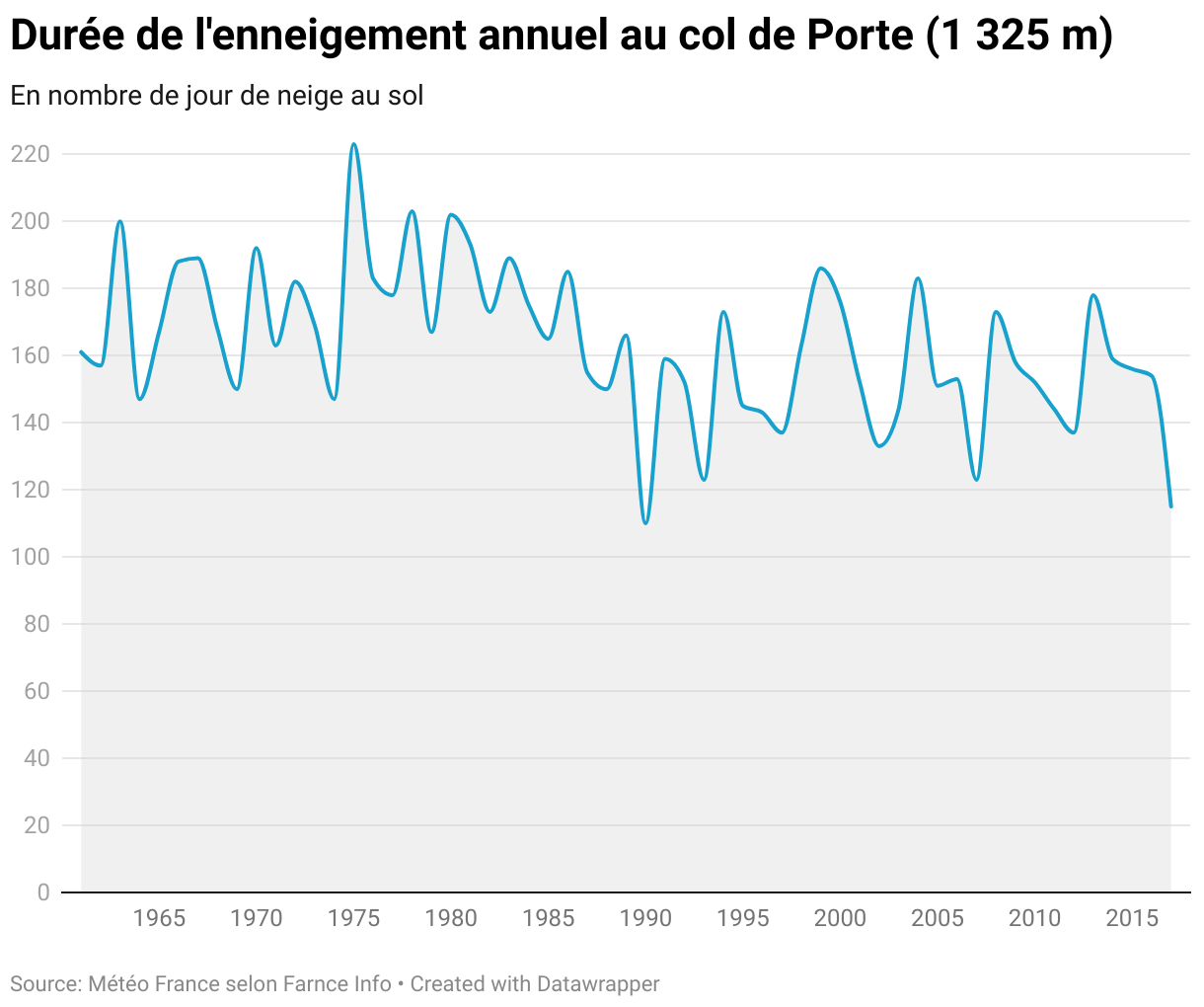
While snow depth at altitude in the French Alps hasn’t changed in 20 years — aside from the usual year-to-year variation — Météo France is predicting declines by 2050. For now, above a certain altitude, things could be said to be holding up well. Looking at the last 20 years of snow records at altitude, there’s no visible decline in snow cover in either December or April. Lower down, at the Col de Porte for example, the trend is a steady decline in the number of days with snow on the ground. Here’s a breakdown of the changes underway, based on French weather stations — though the same broad patterns hold true across the wider Alps, from Switzerland and Italy to Austria.
Less Snow at Mid-Altitude
At the Col de Porte, the Météo France reference station for tracking snow cover, the trend is clear: we’ve been losing 5 days of snow on the ground every 10 years for several decades now. The weather station, set at 1,325m, has recorded snow data since 1961. The chart below clearly shows the downward trend, but also winter’s resilience, for now.
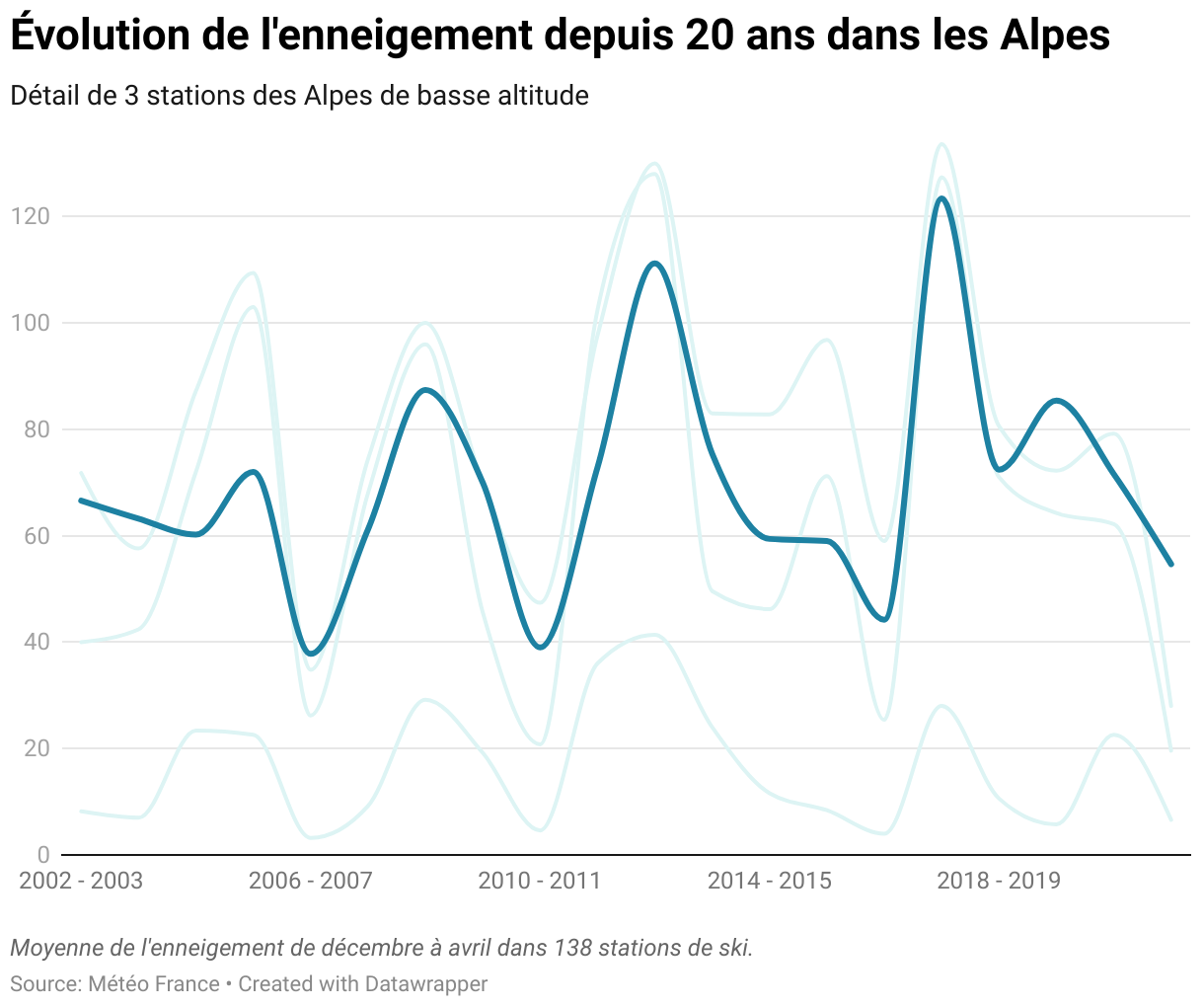
In the chart below, however, you can see how average snow cover has evolved at weather stations located between 1,000 and 1,500 metres altitude, in some of the wettest regions of the Alps. While drawing firm conclusions over just 20 years is difficult, you can clearly see the struggles these stations face during low-snow years or mild winters. At 1,000 metres, snow is even regularly absent altogether.
No Change at High Altitude
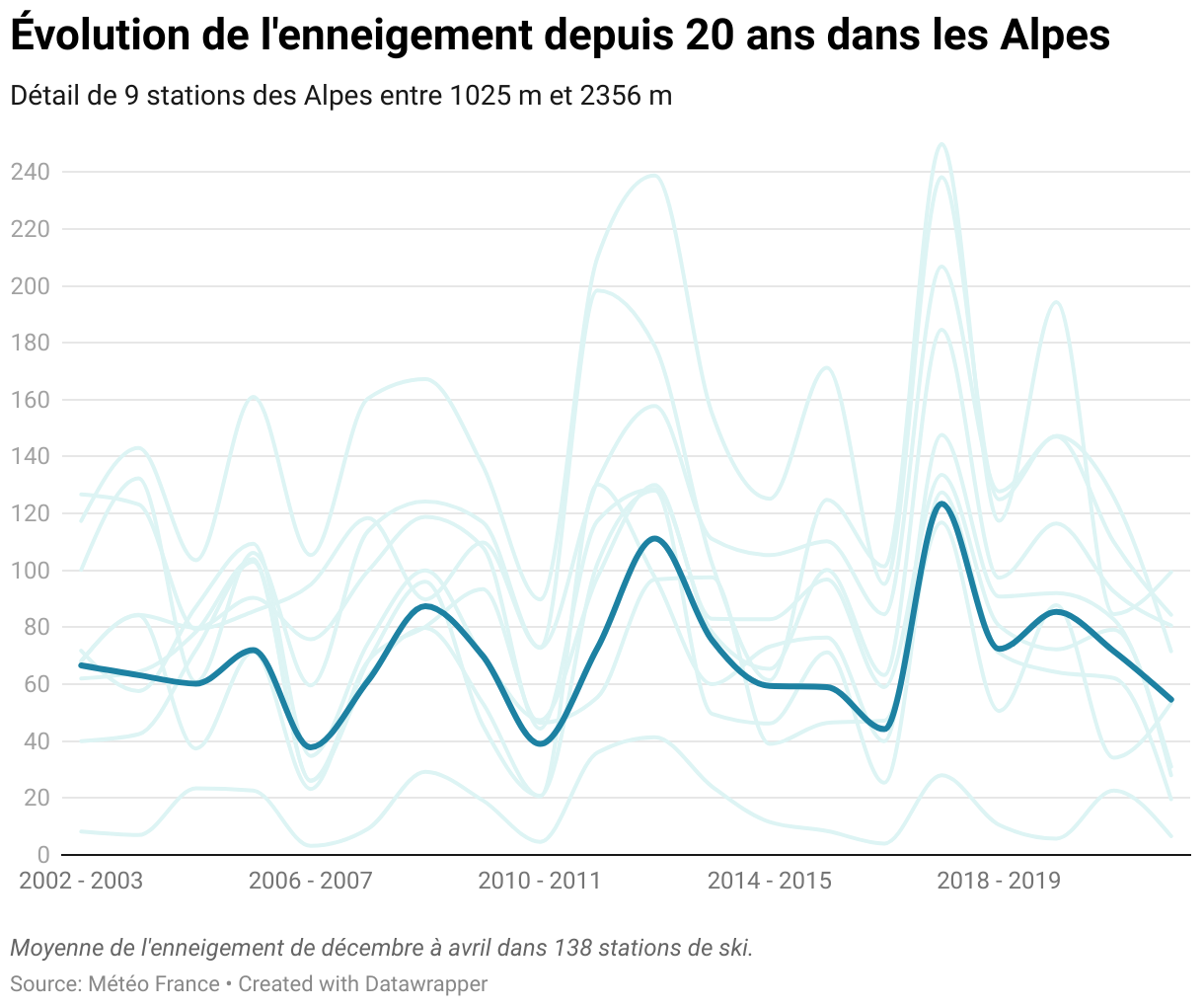
Higher up, however, no change is visible at all. The last 20 years of snow records show strong year-to-year variability, but no downward trend. This holds true in the Prealps, the inner Alps and the Southern Alps alike — and the same picture emerges across the Alps as a whole, well beyond France’s borders.
Less Snow by 2050
Even though conditions still look very favourable for skiing above 1,700 metres, they’re likely to deteriorate in the years ahead. Météo France’s Climadiag tool offers projections for French towns and communes out to 2050. In French ski resorts, a noticeable rise in temperature combined with a decline in snow cover is expected in both the Prealps and the inner Alps — and the underlying climate drivers are shared across the whole Alpine range, so similar shifts are expected in Swiss, Italian and Austrian resorts too. As we’ve seen in recent years, this rise in temperature can come hand in hand with heavy rainfall at altitude, washing away the snowpack and the ski slopes, regularly up to 2,000 metres and sometimes as high as 3,000 metres.
In detail, at Bessans, Météo France forecasts a rise of 1.3° and a 55% drop in the number of days with more than 50cm of snow on the ground. The number of frost days could fall by 32 days a year. It’s worth noting that a Météo France study suggests artificial snowmaking should protect skiability in the vast majority of resorts through to 2050.
Below is the data for 10 resorts across the Alps. Bear in mind these remain average predictions, based on current models and knowledge. The actual situation could turn out considerably better, or considerably worse, by then!
La Clusaz in 2050
(900m – Haute-Savoie)
🌡️ +0.7° in winter (+2°)
🥶 89 frost days (-31 days)
❄ 3 days with 50cm of snow (-83%)
Saint-Sorlin-d’Arves in 2050
(1500m – Savoie)
🌡️ -0.5° in winter (+1.4°)
🥶 116 frost days (-34 days)
❄ 19 days with 50cm of snow (-68%)
Val d’Isère in 2050
(1800m – Savoie)
🌡️ -3.9° in winter (+1.8°)
🥶 172 frost days (-37 days)
❄ 75 days with 50cm of snow (-35%)
Serre Chevalier in 2050
(1500m – Hautes-Alpes)
🌡️ -1.5° in winter (+2°)
🥶 134 frost days (-37 days)
❄ 14 days with 50cm of snow (-69%)
Allos in 2050
(1200m – Alpes-de-Haute-Provence)
🌡️ -0.4° in winter (+2.3°)
🥶 109 frost days (-40 days)
❄ 0 days with 50cm of snow (-100%)
Chamonix in 2050
(900m – Haute-Savoie)
🌡️ -0.5° in winter (+2°)
🥶 111 frost days (-33 days)
❄ 3 days with 50cm of snow (-80%)
Bessans in 2050
(1800m – Savoie)
🌡️ -3.3° in winter (+2.1°)
🥶 161 frost days (-36 days)
❄ 23 days with 50cm of snow (-68%)
Autrans in 2050
(900m – Isère)
🌡️ 1.6° in winter (+2.4°)
🥶 92 frost days (-35 days)
❄ 1 day with 50cm of snow (-66%)
Montgenèvre in 2050
(1500m – Hautes-Alpes)
🌡️ -0.7° in winter (+2.2°)
🥶 127 frost days (-35 days)
❄ 11 days with 50cm of snow (-75%)
Vallouise in 2050
(1200m – Hautes-Alpes)
🌡️ -0.9° in winter (+2.1°)
🥶 128 frost days (-37 days)
❄ 2 days with 50cm of snow (-82%)