A rising rain-snow limit, one year in five that’s difficult, one year in five “stuffed with snow”, and Prealpine ski resorts that amplify these swings… These are some of the conclusions that emerge from analysing 20 years of Météo France snow records across the French Alps — though the same broad patterns hold true across the wider Alpine range. While December is often a tricky month, March is when you’ll typically find the most snow. Below, you’ll find an analysis of average monthly snow depth across Alpine weather stations.
❄️ In short:
- The last 20 years of records show a notable rise in temperatures, driving the rain-snow limit higher.
- On average, one year in five is marked by difficult, low-snow conditions.
- Resorts in Prealpine areas are particularly affected by these swings, amplifying the effects of climate variability.
- December is consistently a low-snow month, while March stands out as the month when resorts record the best snow depths.
- An increase in rainfall, particularly when it falls on an existing snowpack, speeds up the melting process.
Average Temperatures Are Rising
The two charts below show how February temperatures have evolved at Bessans (1,800m) and Saint-Nicolas-la-Chapelle (800m) over the past 10 years. In both cases — despite very different climatic and microclimatic contexts — temperatures have clearly risen over a short period. This rise in temperature pushes the rain-snow limit higher and speeds up the melting of the existing snowpack. If rain falls on snow already on the ground, melting happens even faster.

Records taken at Embrun since 1973 also show fairly significant year-to-year variation. That said, the underlying trend appears to be a rise of around 2° over 50 years at this spot, in the depths of winter. A 2° rise also translates into an average increase of nearly 300 metres in the rain-snow limit at nearby resorts (Réallon, Les Orres, Risoul…). In plain terms, if it was snowing at around 1,250m near Embrun in 1973, that limit would sit above 1,550m on average by 2026.

Mid-Mountain Areas Are Losing Snow
According to Météo France analysis cited in this France Info article, snow cover is declining by around 5 days every 10 years in mid-mountain areas. It’s the rising rain-snow limit that’s reducing the depth of snow on the ground. In the Alps, these trends have historically been measured at the Col de Porte, a Météo France station in the Chartreuse massif set at 1,325 metres altitude and exposed to a wet Prealpine climate.
The chart below clearly shows the slow but inexorable downward trend in snow cover over more than 60 years. You can also clearly see the year-to-year variability.
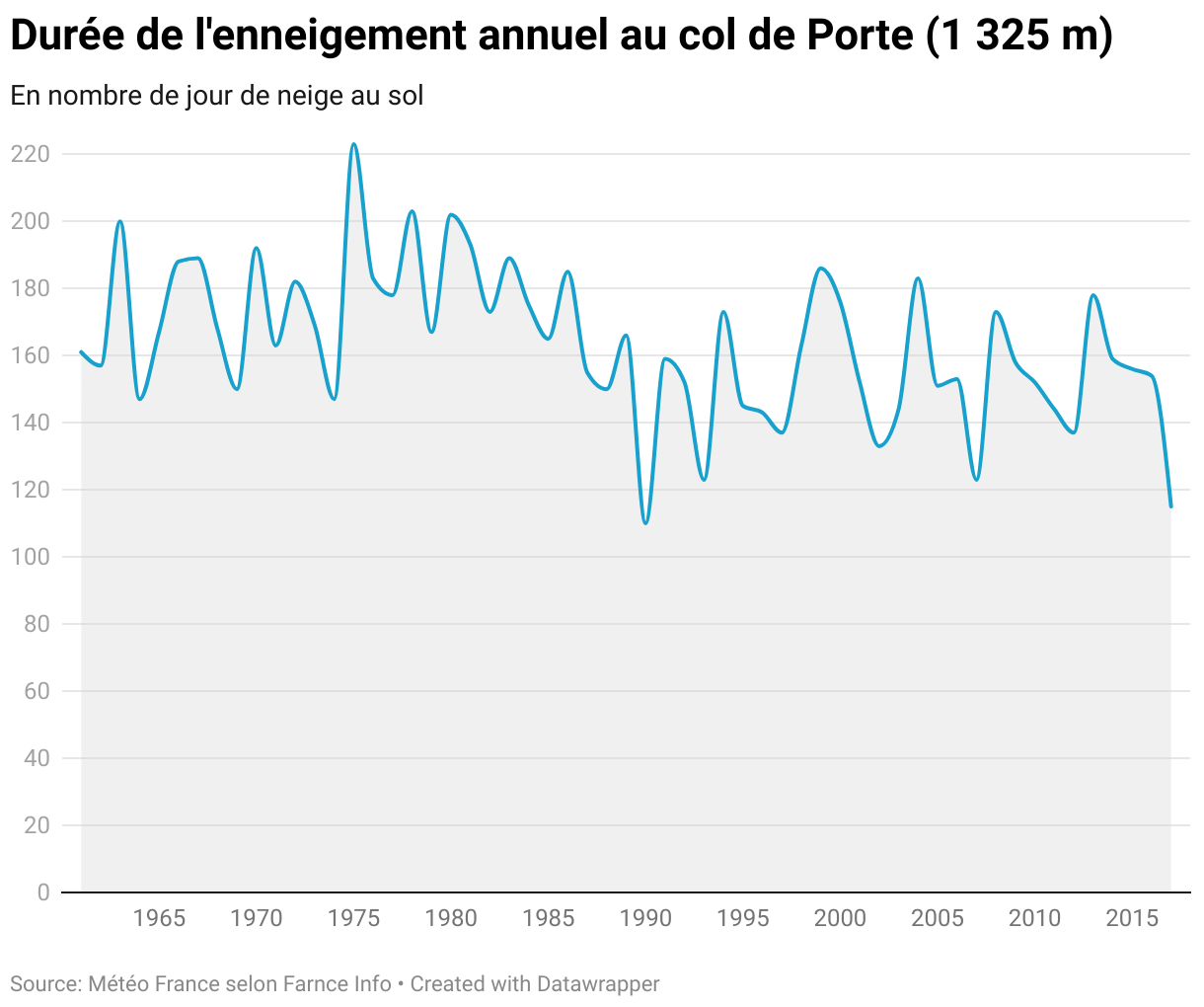
At higher altitudes, no negative trend in snow cover is currently apparent. Snow cover is, however, highly variable from year to year at every altitude. That said, an almost intangible pattern does seem to emerge: roughly one year in five is snow-rich, and one year in five is snow-poor.
March Is the Best-Snowed Month
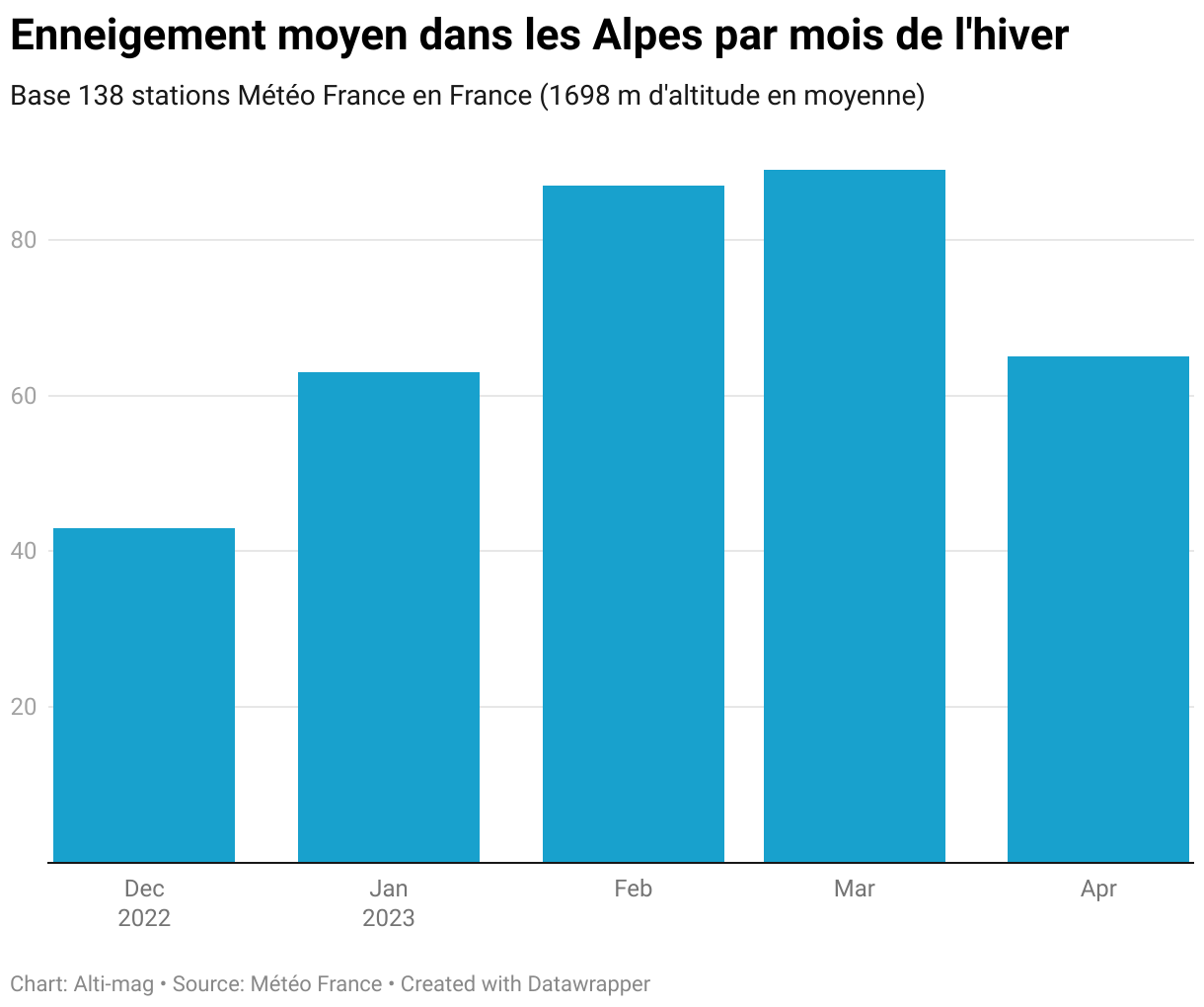
While December is the month with the least snow, March is the best-snowed. February also tends to hold up very well — which is precisely why it’s the most in-demand month: the sun starts climbing higher in the sky, and snow cover is rarely lacking. On average, over 20 years and based on 138 Météo France mountain stations, snow depth reaches 43cm at the end of December, 64cm in January, 87cm in February, 89cm in March and 68cm in April. It’s also worth noting that, contrary to popular belief, there’s actually more snow in April than in January!
Strong Variability, But a Very Regular One…
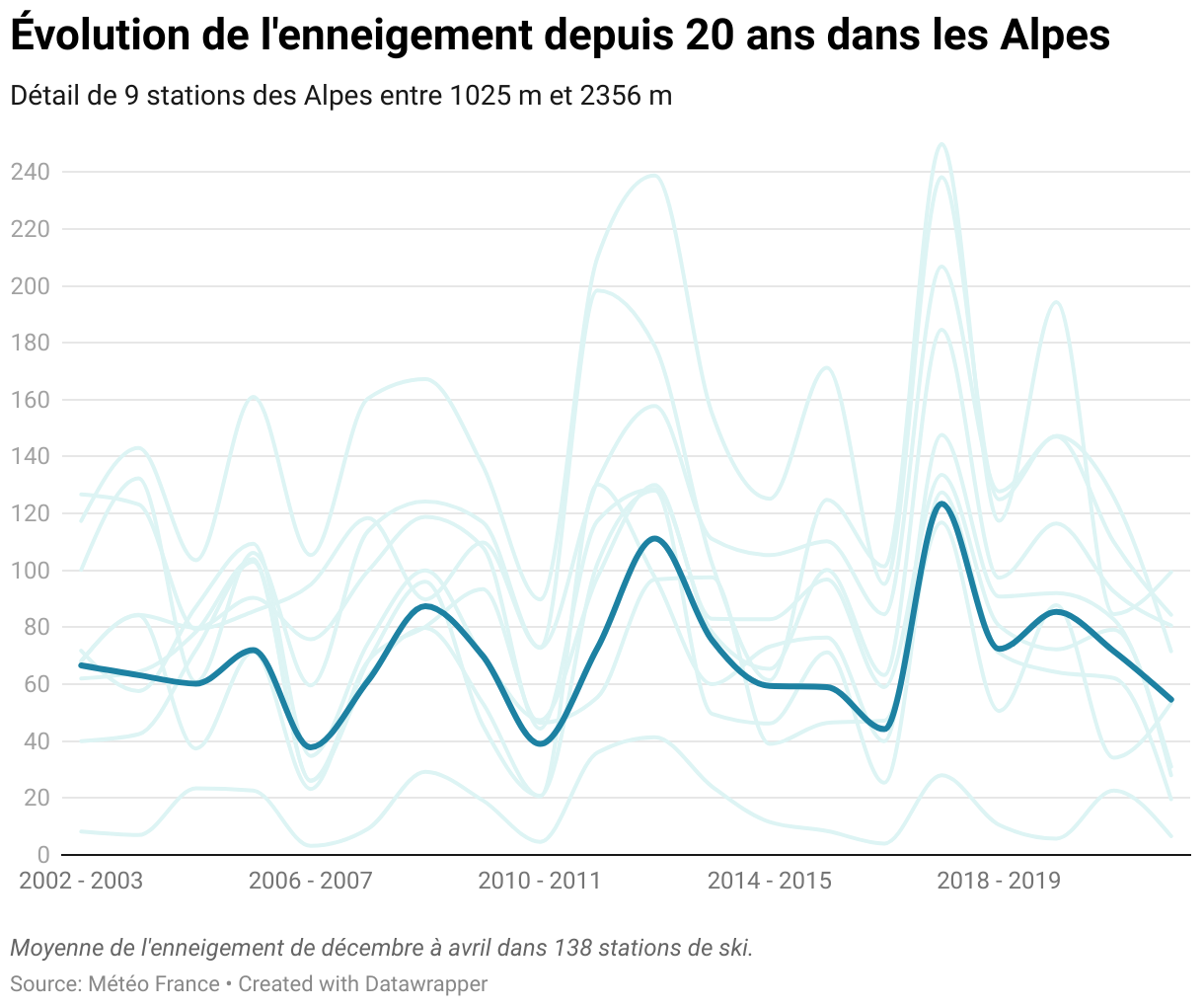
The first thing that stands out when analysing the last 20 years of snow records isn’t the decline in snow cover — it’s the remarkable regularity of good and difficult winters alike. This variability shows up at every resort. It’s linked to the dry and mild spells that can settle over the Alps in winter. You can see it in the chart below, and also in the Col de Porte data, which spans 62 years of records. Zigzagging up and down over the last 20 years, snow cover has been excellent roughly every 5 years, and poor roughly every 5 years.

Westerly Airflows: Strength and Weakness
While snow variability is strongly tied to each year’s weather patterns, altitude and exposure to westerly airflows also play a major role. The chart below breaks down the data for 9 Alpine resorts and villages at various altitudes.
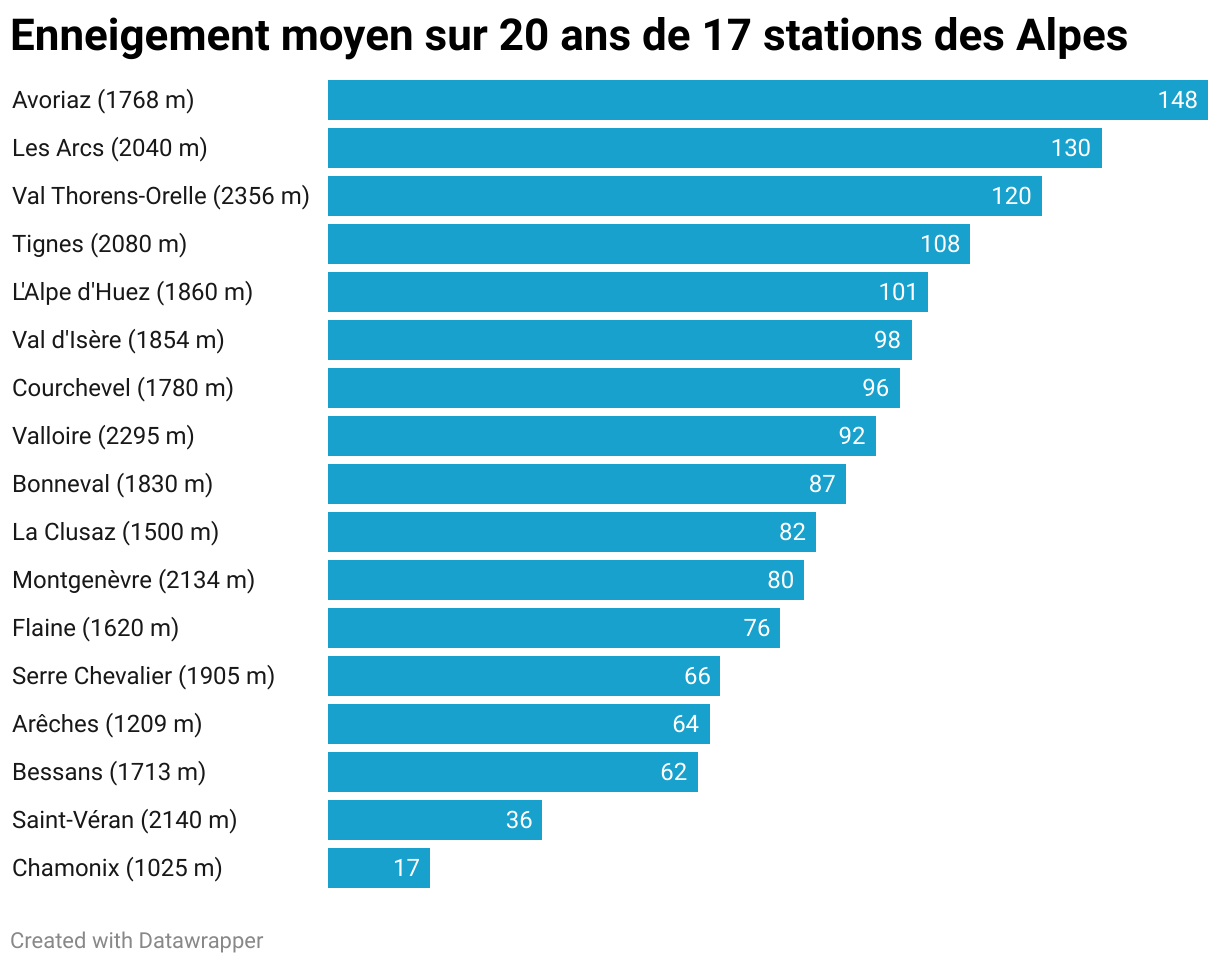
While Val Thorens, Les Arcs and Avoriaz consistently sit above average, Arêches and Flaine tend to amplify the swings. In these resorts, heavily exposed to westerly airflows, winters see below-average snow when the overall winter is snow-poor. Conversely, they see above-average snow when the winter is snow-rich overall.
Below a certain altitude, however, snow all but disappears. That’s the case in Chamonix, at 1,025 metres altitude, where snow is becoming increasingly rare.
Where Can You Find Snow for Sure?
To find snow for sure, your best bet is a high-altitude resort as far north-west in the Alps as possible. That way, it’ll be exposed to westerly airflows and will receive most of its precipitation as snow. Avoriaz and the altitude sectors of Chamonix fit this description. So do Les Arcs and Val Thorens, even though they’re somewhat more sheltered by the Alps range. Be warned, though: in recent winters, we’ve seen torrential rainfall in the depths of winter wash away the snowpack up above 2,000 metres. Being sheltered from westerly airflows can therefore become an asset in its own right. Bessans, Val d’Isère, Serre Chevalier and Montgenèvre are high-altitude resorts that are more resilient to westerly airflows.
A Snowless December: Greater Variability
The chart below shows average December snow depth over the last 20 years. Snow cover is measured across 138 French Météo France stations, at an average altitude of 1,700 metres. 17 Alpine ski resorts are also included. You can see that there have been some exceptional Decembers, but also several fairly critical ones at lower-altitude resorts: 2003, 2004, 2007, 2010, 2014, 2017, 2019, 2022 and 2025. That means roughly a third of winters start with a low-snow December at lower altitude.
At Avoriaz, Val Thorens or Les Arcs, on the other hand, this is very rare.
