The French Alps are more than a mountain landscape — they are one of the last great refuges of European biodiversity, shaped over millennia and increasingly protected against the pressures of mass tourism and climate change. Since the 1960s, France has built a multi-layered system of environmental protection across the Alpine massif: three national parks, several regional nature parks covering the pre-Alpine ranges, and around thirty nature reserves targeting the most fragile ecosystems. This guide explains what each status means for visitors — and where the boundaries lie.
Map of protected areas in the French Alps
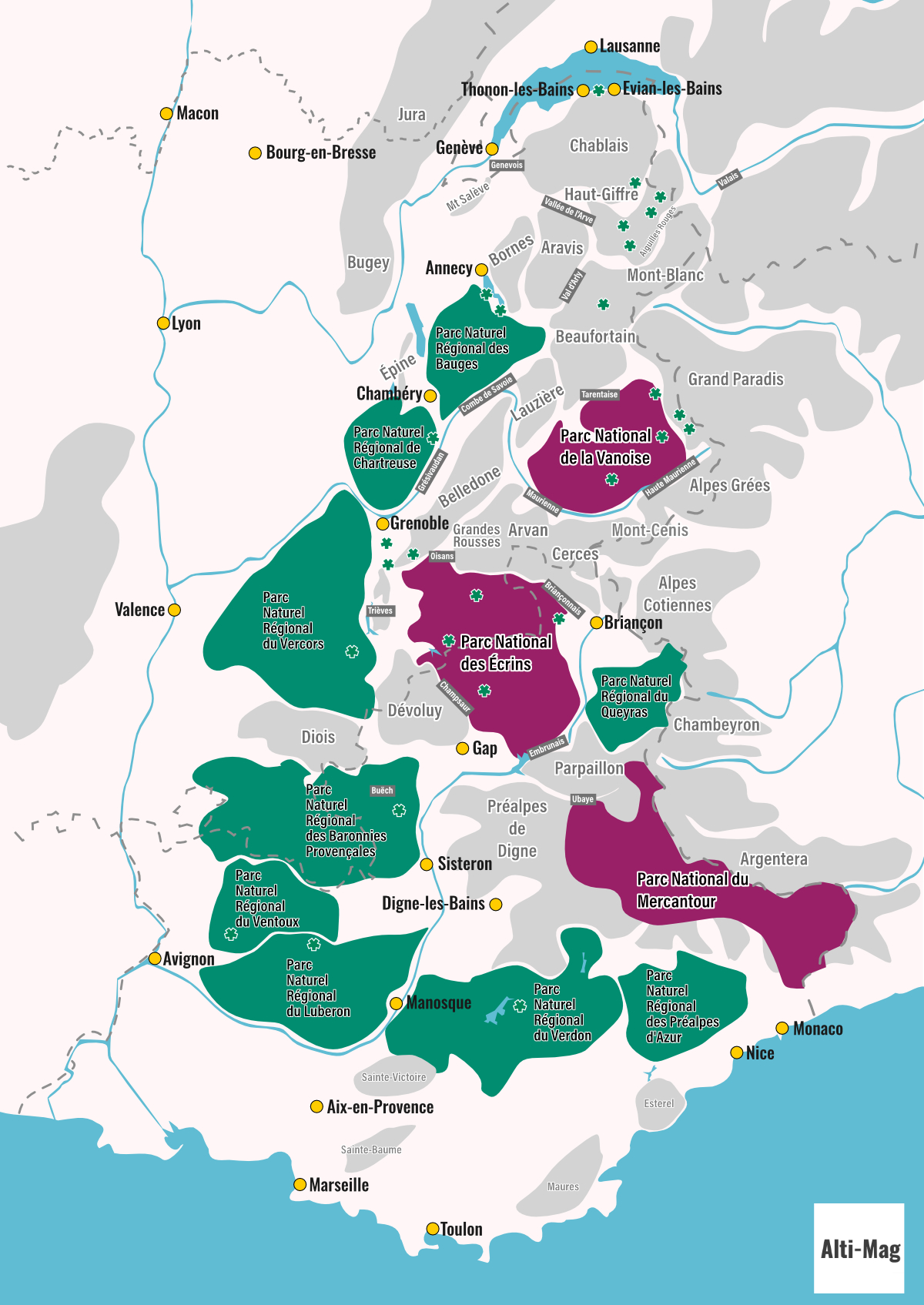
The map shows all protection zones covering the massif in 2026 — the three national parks, the extensive belt of regional nature parks, and the location of the major nature reserves. These boundaries are often invisible on the ground but essential to know when planning hiking routes, camping or drone use, as each zone has its own specific regulations.
National parks — the high-mountain sanctuaries

Created by the French state, national parks represent the highest level of nature protection in France. They operate on a two-tier model that is important to understand before visiting:
The core zone (zone cœur) is strictly regulated — its exclusive aim is the preservation of the natural environment, fauna and flora. Rules are non-negotiable: no dogs (even on leads, to avoid stressing wildlife), no drone flights, strictly controlled plant picking, no fires, and wild camping is prohibited. Overnight bivouac very close to certain mountain refuges is sometimes tolerated.
The optimal adhesion area (aire d’adhésion) is made up of surrounding communes that have voluntarily signed the park charter. The aim here is not strict preservation but sustainable development — balancing environmental protection, responsible tourism and local economy. This zone has shrunk significantly in some parks (particularly Vanoise) as ski resorts have opted out of the charter.
The French Alps have three national parks, each with a strong individual identity:
- Parc national de la Vanoise — created in 1963, the oldest national park in France. Founded largely to save the Alpine ibex from extinction (a mission it has spectacularly fulfilled), it stretches between the Tarentaise and Maurienne valleys. Famous for its vast glaciers and remarkably accessible wildlife, it was also created partly in reaction to the rapid ski resort development of the 1960s Tarentaise.
- Parc national des Écrins — often described as the Alpine national park par excellence: the most mineral, the most rugged and the most remote. Crowned by the Barre des Écrins (4,102 m), it is a paradise for serious mountaineers and committed hikers. Several deep valleys penetrate the massif — Guisane, Valgaudemar, Vallouise, Freissinières — each a world apart.
- Parc national du Mercantour — at the southern end of the massif, straddling the Alpes-Maritimes and Alpes-de-Haute-Provence. Its position at the crossroads of Alpine and Mediterranean climates gives it exceptional endemic biodiversity. Famous for the natural return of the wolf from the 1990s, and for the Valley of Wonders (Vallée des Merveilles) — an open-air museum of tens of thousands of Bronze Age rock engravings at altitude.
Regional Nature Parks (PNR) — inhabited landscapes and rural heritage

Unlike a national park, a Parc Naturel Régional (PNR) is not primarily a strict nature reserve — it is an inhabited territory, often with a fragile rural economy, recognised for its exceptional natural and cultural heritage. The aim of a PNR is to protect this heritage through appropriate management and sustainable development.
Regional parks have no coercive regulatory power equivalent to a national park core zone. Their action is based on voluntary commitment — communes sign a 15-year charter to promote local agriculture, crafts, traditional architecture and green tourism. Visitors are generally free to explore with no additional restrictions beyond normal countryside rules.
The Alpine and pre-Alpine arc is rich in regional parks, forming a belt of inhabited landscapes around the high summits. From north to south:
- PNR des Bauges — a genuine agricultural and mountain enclave preserved between the Savoyard urban areas, known for its authentic rural character and the Tome des Bauges AOP cheese.
- PNR de Chartreuse — a massif of valleys and high plateaux dominated by the Grande Chartreuse monastery — the original home of Chartreuse liqueur — with dense forests and spectacular limestone cliffs.
- PNR du Vercors — a limestone citadel with vertiginous roads cut into the rock, a key site of French Resistance history, and a paradise for caving and cross-country skiing.
- PNR du Queyras — one of the highest regional parks in France, known for its high-altitude villages (including Saint-Véran, the highest village in France), centuries-old woodcraft traditions and landscapes bathed in southern sunshine.
Moving south, the Alpine character gradually gives way to Mediterranean influence — the relief softens, limestone warms in the sun, lavender fields and olive groves appear. This transition zone is marked by a succession of remarkable parks: the PNR des Baronnies provençales, the PNR du Mont Ventoux (the mythic Giant of Provence), the Luberon, the Verdon (and its extraordinary gorges) and finally the Préalpes d’Azur, perched above the French Riviera.
Nature reserves — targeted ultra-protection
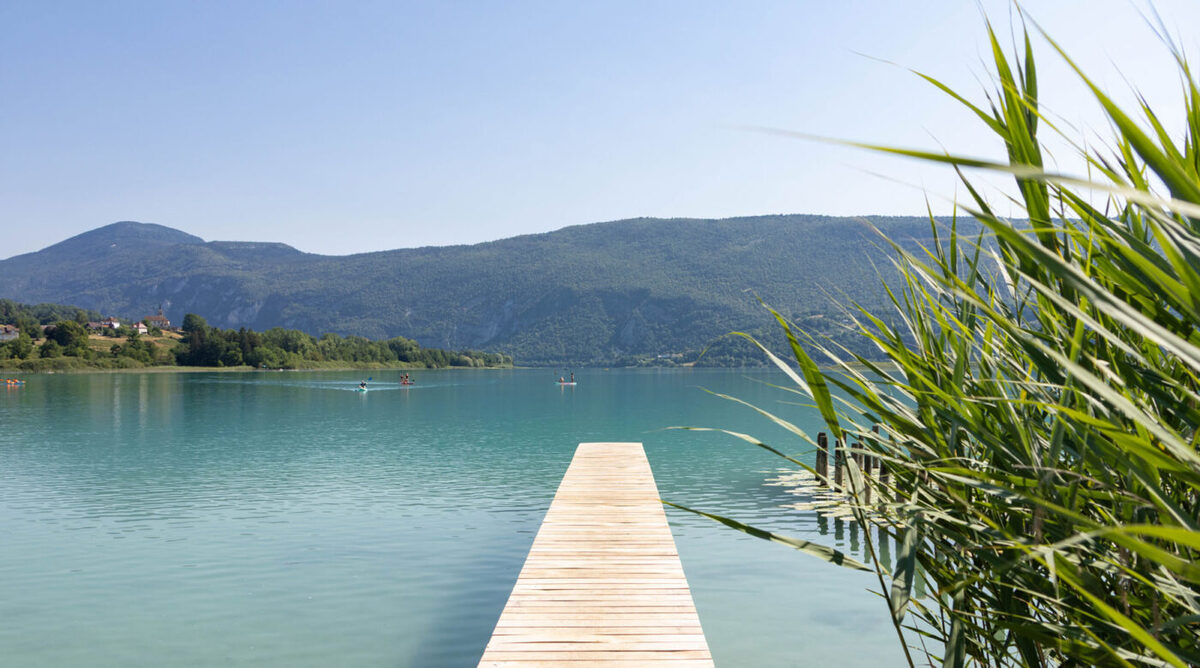
A nature reserve is a powerful site-specific protection tool, typically applied to a much smaller area than a regional park. Its purpose is to safeguard a particular environmental gem: an especially fragile ecosystem, a breeding area for an endangered species, or an exceptional geological heritage. A nature reserve often sits within a regional park or national park adhesion area, adding a stricter layer of legal protection to a specific zone. There are around thirty major nature reserves in the French Alps. Four of the most distinctive:
- Réserve naturelle des Hauts Plateaux du Vercors — although contained within the Vercors Regional Park, it has full reserve status. At 17,000 hectares, it is the largest land nature reserve in mainland France — with no paved roads and no permanent habitation. A sanctuary for the black grouse (tétras-lyre) and for hikers seeking genuine solitude.
- Réserve naturelle du Lac d’Aiguebelette — protecting France’s third-largest natural lake and its extensive reed beds. Motorboats with combustion engines are strictly forbidden, guaranteeing exceptional tranquillity, unusually warm and pure water, and preserved birdlife. See our guide to Lac d’Aiguebelette.
- Réserve naturelle de Passy — in Haute-Savoie, offering a spectacular balcony facing the Mont Blanc massif. Ranging from 1,300 to 2,900 m altitude, it protects highly contrasting environments and serves as a refuge for ibex, chamois and bearded vultures (gypaètes barbus).
- Réserve Naturelle Géologique de Haute-Provence — uniquely, this reserve was created not to protect current wildlife but past life: the largest geological reserve in Europe, protecting exceptional ammonite fossil slabs and dinosaur footprints millions of years old.
Behind the diversity of their designations and regulatory levels, national parks, regional parks and nature reserves share a common ambition: to ensure that the mountain remains a living, resilient space. Understanding the role of these territories is the first step towards a genuinely respectful visit.
👉 Read also: Most beautiful villages in the French Alps · 10 essential hikes in the Northern French Alps · Best French Alpine cheeses · Best French Alps resorts for a summer holiday