In a week on the slopes, a complete beginner can progress from the nursery slope to comfortable blue runs. But ski resorts are not like theme parks — they involve multiple separate operators, specific equipment and a vocabulary that is not self-explanatory. This guide covers everything you need to know before your first ski holiday in the French Alps: what to buy, how the slopes are graded, and which resorts are best for learning.
The basics — what you need before you ski

To learn to ski well you need easy runs, dedicated beginner infrastructure, affordable lift passes and a ski school. While most resorts have these elements, easy terrain and low-cost passes are not equally distributed. Some large resorts offer free or very cheap beginner lift passes for their learner areas; some small resorts are ideal for a relaxed first experience. Three things you need to sort out before getting on a ski lift:
- Hire ski equipment — skis, boots and poles from a ski hire shop in the resort or town below. Most shops also rent helmets. Always hire rather than buy for your first week.
- Buy a lift pass (forfait) — this is your ticket to use the ski lifts for a given period. Day passes, half-day passes, multi-day and season passes are all available. Prices range from around €8 at a small local resort to over €60/day at major resorts. Beginners often need only a beginner-area pass (much cheaper) for their first few days.
- Book ski lessons — taking a lesson or two (or a full week of group lessons) will save you considerable time and build confidence far faster than self-teaching. Instructors are not usually connected to ski hire shops or the lift company — these are three separate transactions at three separate counters.
Ski school — ESF and alternatives
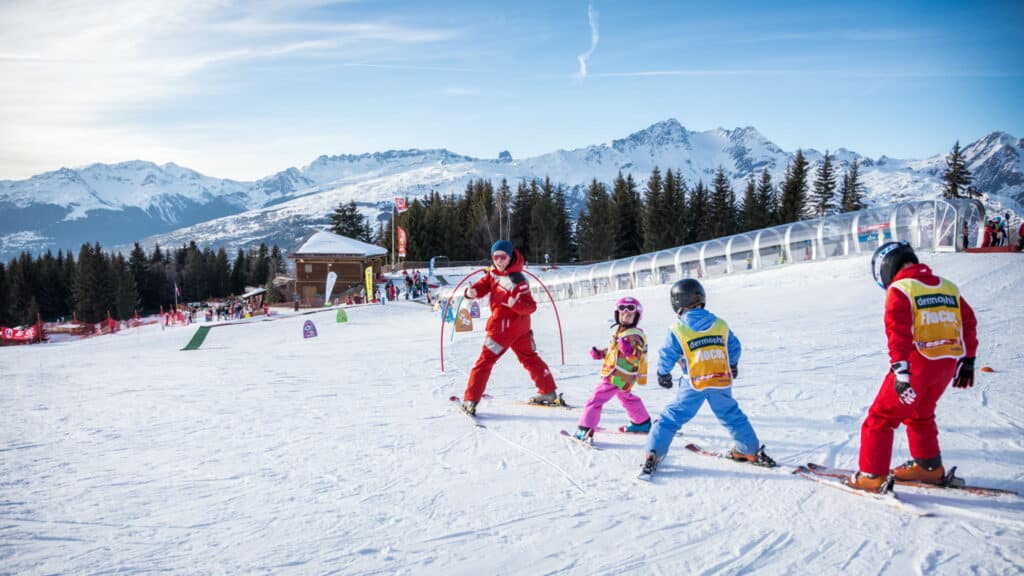
Ski instructors in France must hold a state diploma. Most are affiliated with the École du Ski Français (ESF) — the national ski school, with its distinctive red uniform and presence in virtually every French resort. Some resorts also have ESI (École du Ski International) schools or independent instructors. Group lessons are the standard format (typically 2–3 hours per morning, 5 days) and excellent value. Private lessons give faster progression.
Important for children: if your child is learning on a carpet lift or nursery tow on the front of the resort, the lift pass is often included in the lesson price. If the lesson moves onto the main piste network, a separate lift pass is required — the school will tell you which pass to buy and when. Some children’s classes stay in the “snow garden” for the first 2–3 days before venturing onto the slopes.
Piste colours — how French runs are graded

French ski runs are graded in four colours — which differ from the British system used at indoor ski slopes. Understanding the colour system before you arrive will save confusion on the mountain:
- 🟢 Green (verte) — the easiest runs: wide, gentle gradients, often more like access roads than slopes. Suitable from the first day. You can descend with small turns or even straight.
- 🔵 Blue (bleue) — easy runs requiring control of turns. The target for a competent beginner by the end of a first week.
- 🔴 Red (rouge) — intermediate runs with steeper sections (“murs”) requiring confident edge control and good stopping ability.
- ⚫ Black (noire) — the most difficult runs: sometimes mogulled, with steep walls. Experienced skiers only.
Each resort decides its own colour classifications — a red at a gentle resort may be no harder than a blue at a steep one. As a general target: after one week of lessons, you should be able to ski comfortably on blue runs.
Types of ski lift
There are several types of ski lift in French resorts. Carpet lifts and button tows (téléskis) are the easiest for beginners — no skill required to board. Chairlifts (télésièges) carry you seated and require basic coordination to board and exit. Gondolas and cable cars (télécabines, téléphériques) have the highest capacity and are the easiest to board — you simply walk in. The piste map shows lift types as straight lines and ski runs as coloured curves.
Other winter activities to try

Downhill skiing is not the only option in a French ski resort. Cross-country skiing (ski de fond) uses different, lighter equipment and involves moving across groomed flat or gently undulating tracks by muscle power rather than gravity — requiring a separate, cheaper lift pass. Snowshoeing (raquettes) is simply walking in the snow using plastic snowshoes attached to your boots — no technique required. Both are excellent options for a rest day from downhill, or for those in the group who decide downhill is not for them. Paragliding from the slopes and dog sledding are also on offer at many resorts.
Small resorts for learning — ideal for day trips

For a first experience on skis — particularly if you are based near the Alps and want to try it before committing to a full holiday — a small local resort is ideal. You do not need dozens of runs; one or two gentle slopes is plenty for getting to grips with the equipment and the sensation of sliding on snow.
Small beginner-friendly resorts in the French Alps include Mont Ventoux (Vaucluse), Col du Barioz and Col de Porte (Isère), Col du Granier (Savoie), Le Semnoz, Les Habères, Cordon and Montmin (Haute-Savoie) and Lus-la-Jarjatte (on the borders of Drôme, Isère and Hautes-Alpes). These are often community-run, with one or two tows and a handful of runs. Day passes range from €8 (Col du Barioz) to €23 (Les Habères, Cordon).
Always check snow conditions online and on webcams before visiting these low-altitude resorts — they depend entirely on natural snowfall and are not always open.
Village resorts — best for a beginner week
If you are staying for a full week, small resorts without accommodation or shops will be limiting. The ideal is a village resort with a small but genuine ski area, good accommodation and local life — enough to ski every day without getting bored, but without the overwhelming scale of a major resort.
Southern Alps: the villages of Névache, Vallouise-Pelvoux, Crévoux and Arvieux all have small downhill ski areas, cross-country trails and snowshoe routes — excellent for varying the experience across a week.
Northern Alps: Bessans, La Féclaz, Praz-de-Lys, Les Habères, Saint-Jean-d’Aulps and La Chapelle-d’Abondance offer the same balanced mix. Day passes from around €12.
Learning to ski at a large resort — the best beginner areas
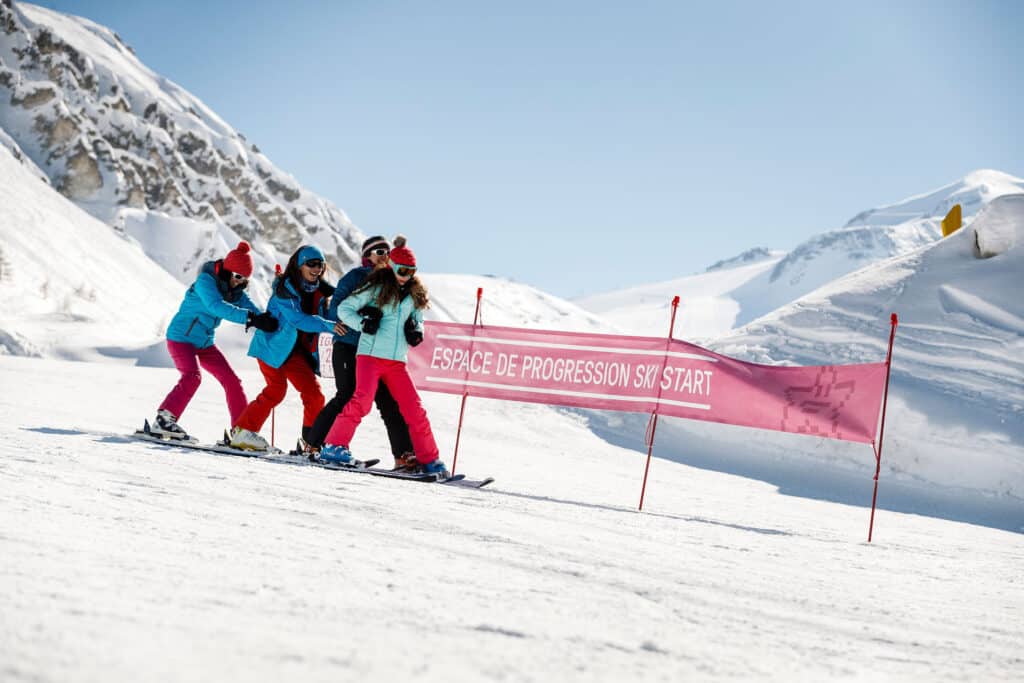
If you are travelling with confident skiers who need access to a large resort, the good news is that several major French resorts have excellent — and affordable — dedicated beginner areas. You do not have to pay full resort prices just because you are learning:
- Tignes — one of Europe’s largest ski resorts, with entirely free beginner areas: small lifts and carpet tows on the snow-front at no charge. An excellent solution if the rest of your group wants a big resort.
- Alpe d’Huez — a sunny, south-facing resort with a very progressive piste network and dedicated beginner lift passes at reduced rates.
- Les Gets — a dedicated free beginner zone with two carpet lifts, a button tow and a drag lift on four gentle slopes. One of the best-organised beginner setups in the Northern Alps.
- Chamrousse — a “mini-domain” pass giving access to the Arselle chairlift, four button tows and a snow play area at a reduced rate. Close to Grenoble.
- Saint-Gervais — mini-domain passes allowing progressive learning without the cost of a full resort pass. Ski lifts linked to Megève for those in the group who want more.
Most resorts have some form of beginner area, though they do not always advertise it prominently. These areas are sometimes free, sometimes around €10 per day. Always ask at the lift pass office on arrival whether a beginner pass exists before purchasing a full pass.
For popular resorts during school holidays (February half-term, Christmas week), yes — group lessons at the main ESF schools can fill up weeks in advance. For quieter periods or smaller resorts, booking a few days ahead is usually sufficient. Private lessons should always be booked in advance. Most ski schools now offer online booking.
A rough budget for a first-time adult skier for one week: ski hire €80–150, lift pass €100–250 (less if using a beginner-only pass), group lessons €150–200 for 5 mornings, helmet hire €20–40. Total equipment and passes: approximately £350–550 per adult per week, excluding accommodation and travel. Children’s costs are typically 20–30% lower.
Both work, for different reasons. Small resorts are less intimidating, less crowded and cheaper — ideal for a first day or two. Large resorts with dedicated beginner areas (Tignes, Les Gets, Alpe d’Huez) work well when travelling with confident skiers who need a full ski area — you learn on the free beginner zone while they access the full domain.
Ski equipment is hired in resort — you do not need to buy anything before you arrive. From a ski hire shop: skis, ski boots and poles. You will also need: a helmet (hireable in resort, highly recommended), ski gloves (buy before you go — cheaper than in resort), ski goggles (buy before you go), waterproof ski jacket and salopettes/ski trousers, thermal base layers and ski socks (wool or synthetic, not cotton). Ski socks should be long and snug-fitting inside the boot.
👉 Read also: Highest ski resorts in the French Alps · Best value ski resorts in the French Alps · Driving to the French Alps from the UK · French ski resorts with the most green runs